

When Did Owning An Animal Become Popularized In America
Pets in Colonial America were kept past the colonists for the same reasons they were in Europe: for companionship and, in the instance of dogs, for protection, hunting, and herding. Cats controlled vermin in homes and barns until the 18th century when they became valued as house pets.
The colonists kept many different animals every bit pets, all the same, including squirrels, wild birds, raccoons, deer, horses, snakes, frogs, and turtles, among others. The settlers brought their own dogs, horses, and cats from Europe and afterwards tamed other animals – like deer, otter, and beaver – they encountered in North America.
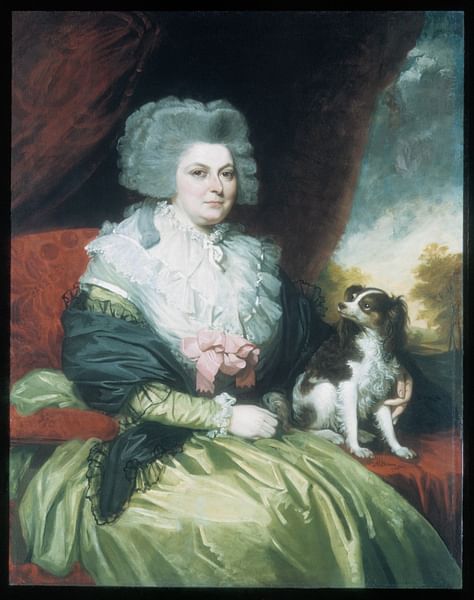
Lady with a Dog
Long before the inflow of the first Europeans, the Native Americans had also kept pets, primarily dogs and turkeys although in that location is bear witness that bobcats were likewise domesticated. The Native Americans kept dogs for the aforementioned purposes as the colonists but also used them to transport goods via sledges attached to harnesses tied effectually their torsos. Early colonial accounts depict dogs being used in this way just, somewhen, the natives adopted the dog collar from the Europeans and the harness was used less oft.
Each tribe had different dog breeds used for different purposes in the same way they observed diverse traditions singled-out from each other. In that location was no single Native American canis familiaris in North America. The colonists, on the other hand, were more uniform in their apply of dogs – and pets in general – and the European model somewhen became standard across the state. In the present solar day, pet owners still adhere to this same model observed in Colonial America.
Native American Dogs
Exactly when and where dogs were first domesticated continues to be debated simply it is thought that they were not native to Due north America but arrived with Paleoindians who migrated into the state across the Bering Land Bridge (too known as Beringia) over 14,000 years ago. Scholar Marion Schwartz comments:
Dogs are remarkable considering they are uniquely sensitive to the cultural attributes of the people with whom they live. Not only are dogs a product of civilization, just they also participate in the cultures of humans. In fact, dogs were the first animals to have up residence with people and the just animals found in human societies all over the globe. Because of the ubiquity across cultural boundaries, dogs have been so commonplace that their history seemed to warrant little consideration. And however for the past twelve thousand years dogs have played an integral part in man lives. What is most remarkable nigh dogs is their ability to adapt to the needs of the people with whom they alive. Dogs accept proved themselves amazingly flexible beings, and this was equally true in the Americas every bit elsewhere in the world. (2)
The get-go dog to enter North America is idea to be a kind of dingo, although this claim has been challenged, and information technology is possible there were a number of different breeds who arrived with the early human immigrants. Dogs were used to protect homes and villages, for hunting, transporting goods via sledges, and in the case of the westward coast Salish brood (a larger version of the Pomeranian), their fur was used to make mats and blankets. Some tribes kept dogs equally pets and as well as a food source, others primarily every bit guardians and hunters, but all considered dogs as valuable avails.
Dogs were considered intermediaries between the seen & unseen worlds, the realm of mortals & of the gods.
Dogs were highly regarded every bit a gift from the gods, and although there are many dissimilar myths relating how the dog came to alive among human beings, the story of the Dog and Not bad Medicine from the Cheyenne of the midwest is typical. The creator-god Keen Medicine made homo beings later creating the world and showed his people a land covered in fields of corn and thick with herds of buffalo. The Cheyenne appreciated the gifts but had no means of following the buffalo to chase them or of transporting the corn in one case it was harvested. They were likewise sometimes attacked in the night by other tribes who could sneak up on them then even the pocket-size amount of corn and buffalo brought into the hamlet could be taken. Great Medicine showed them how to capture young wolves to raise as pets. These animals then evolved into domesticated dogs who would warn the village of an set on, could transport corn, and would help the people rail the buffalo too equally chase other game.
In some tribal stories, the dog is among the first creatures created, in others, like the Cheyenne, it is a gift given to make life easier for the people. Dogs were considered intermediaries between the seen and unseen worlds, the realm of mortals and of the gods, as they embodied both the wild and the domestic spheres. This view of the domestic dog assorted sharply with the European understanding of the dog as a created existence whose only purpose was to serve people.
Colonists & Their Dogs
Co-ordinate to the Christian Europeans, dogs had no souls – nor did any other animal – as an immortal soul animated only human beings who would answer for the deeds done in life after they died and appeared before the throne of God for judgment. The dog was therefore not viewed as annihilation special and references to dogs in the Bible encouraged this view as dogs are mostly associated with poverty and low social status. To cite only i example, although the biblical tale of Lazarus and the Rich Man from Luke sixteen:19-31 has been interpreted as showing dogs in a positive light (every bit healers who lick the sores of the poor man), they are associated with poverty past this very act.
Fifty-fifty and then, the colonists did non look down on dogs simply cared for them deeply. The first law concerning mistreatment of dogs (or any animal) in the English colonies was the Regulation against Tyranny or Cruelty of the Massachusetts Bay Colony in 1641. Purposeful cruelty toward an animal was punishable by fine or a sentence in the stocks and pillories. Colonists who bred dogs, especially, took great pride in them and elevated their own above those of their neighbors with collars which were frequently ornate and, among the upper-course, quite expensive.
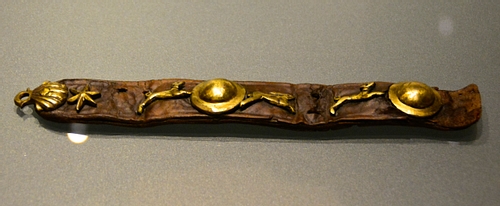
16th-century CE Domestic dog Collar
Leather collars with a brass plate engraved with the dog's name, owner's name, and sometimes a pithy epigram were popular in Europe and mirrored in early Colonial America. Domestic dog ownership came to exist associated with a caste of wealth in that ane could afford to feed a dog likewise as one's family, and the padlock collar was developed, in part, to testify said buying. The padlock collar was a hinged band of metallic attached around a dog's neck by clasps and fastened with a small padlock for which simply the possessor held the key. If the dog were lost or stolen, one could evidence ownership by producing the key and unlocking the neckband equally the piece was impossible to remove otherwise without harming the domestic dog.
Dogs were used for hunting, guarding the habitation, and in claret sports such every bit dogfighting or bearbaiting. Breeds included various hounds, bulldogs, mastiffs, pointers, setters, spaniels, terriers, and others. Smaller breeds were known as "comfort dogs" and were favored by women and the elderly as companions. Upper-class gentlemen, such as George Washington (fifty. 1732-1799) and Thomas Jefferson (1743-1826), kept inventories of breeds and Washington prided himself on his knowledge of dogs. The French general Lafayette (l. 1757-1834), an ally of Washington'due south during the Revolution recognized this and gave Washington 2 Basset Hounds as a gift; thereby introducing the Basset to North America. Another of the all-time-known anecdotes concerning Washington and a dog also comes from the period of the American War of Independence (1775-1783) and relates how, after the Boxing of Germantown in 1777, Washington found the domestic dog of his opponent, General William Howe (l. 1729-1814), and returned it to him with his compliments. Washington knew it was Howe'south dog from the inscription on the canis familiaris'south collar.
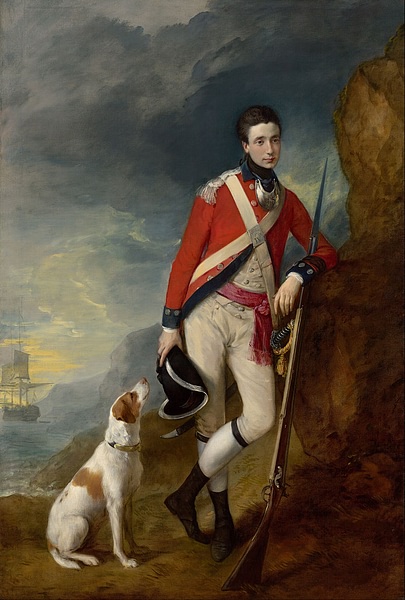
An Officeholder of the 4th Regiment of Human foot, 1776-1780
When a domestic dog went missing, if they lacked identification such as Howe's dog, advertisements would be posted at the local meeting firm, church, or tavern offering a reward for its return, but as people do today. In Colonial Williamsburg, rewards for dogs were offered in the amount of 20 shillings (ix days' wages) between 1774-1777 signifying the value owners placed on their dogs. Advertisements in New York City during the Revolution follow the same model every bit British officers posted many for the return of their lost dogs. Portraits of upper-class gentlemen of the time often evidence them posing with a favorite hunting dog and the same of upper-class women with their condolement dog. Dogs, in fact, brainstorm appearing fairly regularly in family portraits from c. 1700 onwards.
Other Pets
Dogs were non the only domesticated animal to enjoy an elevation in status during the 18th century; cats also became more highly valued every bit companions whereas previously
they had been regarded more than or less as utilitarian pest control. The Historic period of Enlightenment encouraged people to question many of the beliefs and traditions of the past, and among these was the view of the cat as about a necessary evil. Cats were associated with heathen cultures and, information technology was noted, were mentioned nowhere in the Bible, making them doubtable. They were useful in controlling the population of rats and mice, however, and were more tolerated for the near part than cared for.
During the 18th century, the cat became the pampered house pet one is familiar with in the present twenty-four hours.
During the 18th century, however, the cat became the pampered house pet one is familiar with in the nowadays solar day. Family portraits likewise every bit single-figure pieces frequently featured the person's or family'south cat, and they began to appear in poetry and literature. The cat as a witch's favorite familiar, of course, was widely recognized, and they were not embraced equally family members as early as dogs were, but by the time of the American Revolution, they were on at least equal standing with dogs as far as portraiture is concerned.
Deer were also featured in portraits and became one of the most highly sought and popular pets of Colonial America. Deer wore collars and were walked on leashes and, based on their depiction in paintings, lived in the family home as comfortably as cats or dogs. Deer were frequently domesticated and allow loose in the gardens of colonial estates to charm guests at parties, and ane case of this is a Dr. Benjamin Jones of Virginia Colony who trained over one hundred deer for his property for this purpose every bit well every bit for his family to enjoy. Portraits of deer bear witness them in poses very like those of greyhounds of the period with brass colors often of the padlock type.
Some other pet which was frequently featured in portraits was the squirrel whose young became more popular than a puppy or kitten with children of the time. People robbed squirrel nests of their immature, domesticated them, and sold them in the marketplace every bit house pets. These business firm squirrels were collared, leashed, and walked simply every bit comfort dogs were. Flying squirrels were especially popular with immature boys who trained them to sit on their shoulders every bit they walked through boondocks. The popularity of squirrels as pets was lamented by wives and mothers of the fourth dimension, who complained the creatures chewed through closets, habiliment, and linens and could not be contained because they could eat their way through wooden boxes or cages. Tinsmiths capitalized on this by creating metal cages with do wheels and other items inside and then the squirrel could still entertain a family unit just remain contained.
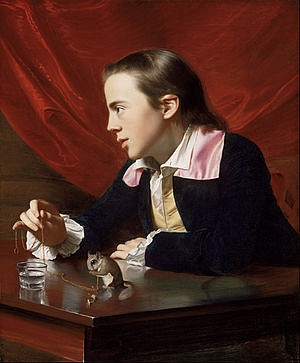
A Male child with a Flying Squirrel
Domesticated birds were peculiarly popular with young girls and women, who kept cardinals and others in often elaborate cages in their drawing rooms. Information technology was believed that one could teach a bird a melody by repeating it and so small flutes known as flageolets became pop amongst bird owners. The person would repeat a unproblematic tune on the instrument throughout the day, and it was thought the bird would learn to sing information technology. There are no records of this do actually succeeding, however, except in the case of the mockingbird.
Beavers were also popular, mainly among men and boys, and were trained to catch fish and carry them home. Otters were trained to retrieve game that fell into water, in the same mode hunting dogs previously had been. Fishermen, especially, were addicted of trained otters who would dive under the water and render with fish. Raccoons, which were also domesticated, were least pop attributable to their habit of breaking-and-entering pantries and stealing food or various items from homes. No thing how well-trained, a raccoon was also apt to kill the family unit's chickens, which somewhen led to it being dropped as a pet and seen more as a predator and nuisance.
Other animals, such as snakes and small monkeys, continued to be popular fifty-fifty though they presented their own bug. Snakes were peculiarly unpopular amongst women, although women and girls were the primary owners of monkeys who were far more bothersome in maintaining a corking and make clean home. Some other brute pop especially among young girls was the lamb which was often depicted in paintings wearing a ribbon around its cervix. Chickens, of course, also served as pets although no portraits feature them adorned as lambs and monkeys were.
Determination
Changes in pet ownership, concerning the types of animals kept in homes, came with the Industrial Revolution of the late 18th and early 19th century. The British industrialist Samuel Slater (l. 1768-1835) introduced English textile mills into the Us c. 1789. He was assisted past industrialist Moses Brown (fifty. 1738-1836) who established the start water-powered mill in America in Pawtucket, Rhode Island in 1790. The introduction of textile mills proved quite profitable for businessmen and encouraged the development of more than labor-saving engineering, which led to urbanization every bit people moved to cities for work. As industrialization and urbanization increased, pet ownership became more restrictive regarding pick; a city apartment was no place for a deer, horse, or lamb as a pet. Those in rural areas still kept these animals as pets, just they no longer appear in portraiture in the 19th century, and squirrels seem to accept followed this aforementioned refuse in popularity.
Colonization, westward expansion, and further immigration also afflicted which animals were kept as pets. Deer were regularly hunted as food and for their hides even as they were domesticated as pets, but as natural habitats began to compress and deer populations moved further abroad from settlements, communicable and domesticating a deer as a pet became less pop than shooting and eating one for dinner. The snake, and so popular during the Colonial catamenia, followed this aforementioned course as they were driven farther abroad from towns and cities and finally became relegated to the sphere of entertainment past traveling magicians and circus performers by the mid-19th century.
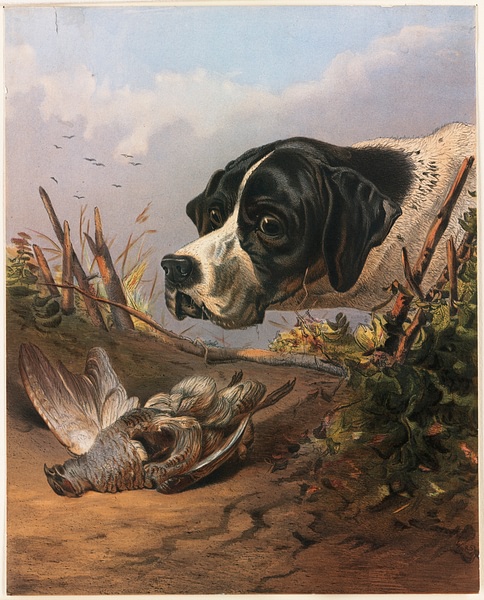
Dog's Head
Equally more than land became settled, and more people needed to exist fed, animals like beaver, otter, and raccoon – which had been hunted for their skin and meat even when they were seen as popular pets - came to be primarily seen as nutrient sources instead of companions and assistants. Native American villages, which had in one case been quite numerous along the eastern seaboard of North America were destroyed by colonists to make room for further settlements, and once the inhabitants were relocated onto reservations, it was illegal for them to own dogs just as it was for them to have admission to firearms. Native American dogs were confiscated, and these dog breeds eventually went extinct from convenance with European dogs and so thoroughly that it is unclear, today, what many of these breeds even were.
Restrictions on types of pets seem to have occurred naturally as more exotic animals became more difficult to come past. Dogs and cats, therefore, became the master pick for most people, and their popularity grew every bit more than homes adopted them. In the present day, the dog and cat keep to be the most popular and common animals kept as pets, although a number of Americans continue to keep exotic animals only as their ancestors did.
This commodity has been reviewed for accuracy, reliability and adherence to academic standards prior to publication.
Source: https://www.worldhistory.org/article/1728/pets-in-colonial-america/
Posted by: kellyeldis1975.blogspot.com
0 Response to "When Did Owning An Animal Become Popularized In America"
Post a Comment